The Devil Wears Prada Breakdown

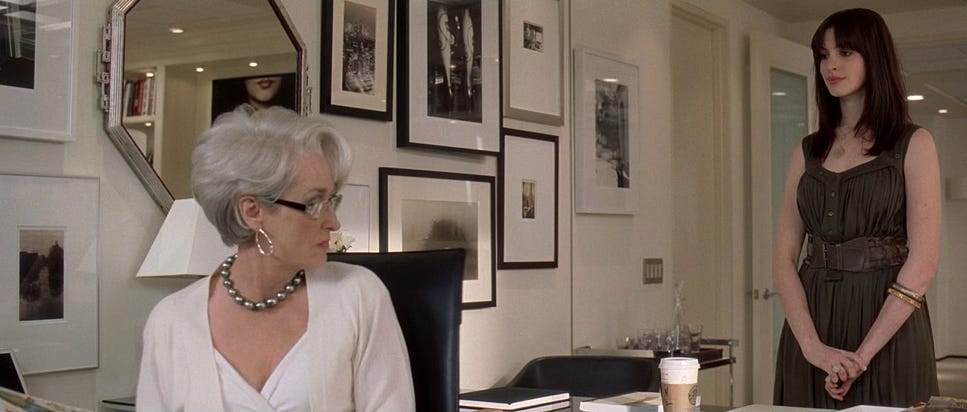
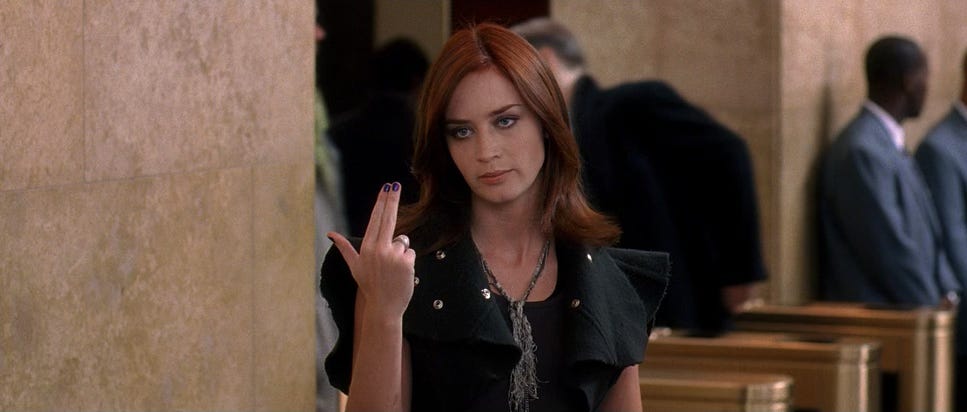
With this year being the 20th anniversary of The Devil Wears Prada and with the release of the highly successful The Devil Wears Prada 2, this seemed like the perfect time to not only do a breakdown of the original film, but also to discuss the film with my friends at Reel Therapy. With an all-star cast of Anne Hathaway, Meryl Streep, Stanley Tucci, Emily Blunt, and Adrien Grenier, The Devil Wears Prada has become a beloved modern classic that has a light, fun, bubbly surface, but also some interesting themes flowing underneath.
As always, these breakdowns contain SPOILERS, and are only recommended if you've already seen the movie. You can check my introduction to these breakdowns, to get an overview of my process and philosophy.
Feel free to let me know what you think in the comments below!
The Basics
Director: David Frankel
Writers: Aline Brosh McKenna and Lauren Weisberger
Release Date: 2006
Runtime: 109 Minutes
IMDB: https://www.imdb.com/title/tt0458352/?ref_=ext_shr_lnk
Movie Level Goals
Protagonist: Andy Sachs
External is interesting and I address it in Observation #1. I see three possibilities:
External #1: Survive at Runway for a year
SUCCESS | FAILURE | MIXED
External #2: Do well enough to get a recommendation
SUCCESS | FAILURE | MIXED
External #3 (my preferred goal): Gain Miranda’s approval
SUCCESS | FAILURE | MIXED
Internal Goal: Decide what her priorities are
SUCCESS | FAILURE | MIXED
Goal Relationship #1: Internal leads to external (Andy decides she doesn’t want to be like Miranda, quits, and doesn’t make it a year)
Goal Relationship #2: External leads to internal (Andy impresses Miranda, but she decides her priorities are to not be like Miranda)
Goal Relationship #3: External leads to internal (Andy gains Miranda’s approval, but it’s a mixed bag, and she decides she doesn’t want to be like Miranda)

Three Observations
Observation #1: The Variety of External Goals
Movie level goals are obviously key to understanding any Hollywood arch-plot. The movie level goal is like the destination you put into Google Maps. Even if as a viewer you don’t know the destination, you slowly figure it out as the movie unfolds (and in some films you do discover it right away), and its certainly important for the filmmakers to know what that destination is.
At the start of The Devil Wears Prada, the movie gives us a couple of clear cut possibilities (as listed above). For example, the audience is given the time frame of one year for Andy to stay at Runway to be successful. This is a perfectly legitimate movie level goal possibility. As we know she fails at this goal. The second is similar, but removes the time frame: do well enough to earn a recommendation. Despite its similarity to the first stated goal, she actually succeeds at this one.
And this is where knowing the goal becomes important—minor variations in how we think about the goal can lead us to think that the protagonist has failed in one variation and succeeded in another, and that obviously can change the tenor of the end of the movie. Do we want Andy to fail (not last a year) or do we want Andy to succeed (get the recommendation)? In the choice between these two variations, we know Andy gets the recommendation and in this case that’s the more important outcome—lasting a year was just the stated means for getting the recommendation, which she manages to get anyway.
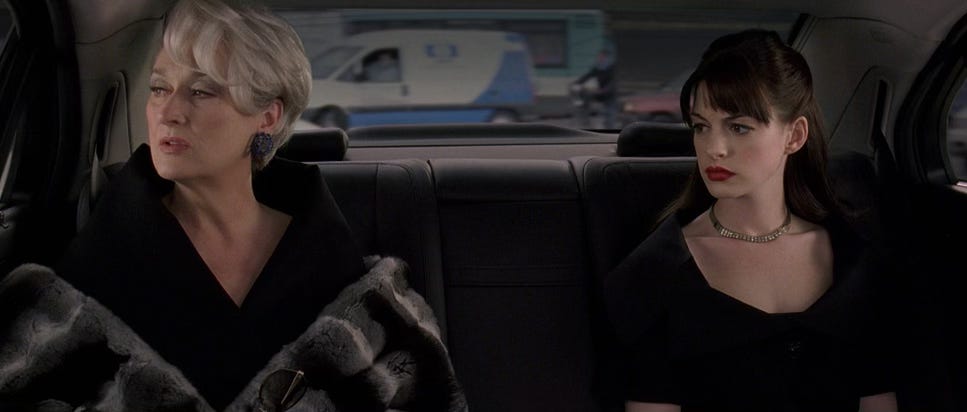
When a variety of movie level goals are possible, one way to try to sort things out is to go to the movie’s climax, and determine what the protagonist succeeds or fails at. In The Devil Wears Prada, the movie level climax comes in the car after Miranda succeeds in keeping her job at Runway. Miranda tells Andy that Andy reminds her of herself. Given that this conversation immediately follows Miranda’s betrayal of Nigel, Andy is not happy with the comparison and rejects it, eventually leading her to exit the car and quit her job. While she does get a recommendation from Miranda in a wrap-up scene, that is not the focus of the car scene. What goal did Andy succeed or fail at when Miranda told her that they were alike? She succeeded in gaining Miranda’s approval. I think that’s the true movie level goal and is by far the most interesting one. On the surface it folds in the desire to do well enough to gain a recommendation (which she does). But what we see over the course of the movie is that after the Act I Climax when Miranda tells Andy she’s disappointed in her and Nigel tells her she could be trying harder, Andy’s movie level goal becomes to gain Miranda’s approval. And I would argue this goes beyond just getting the recommendation. First, Andy is a perfectionist and simply wants to do well. Second, Miranda is a strong, powerful woman and for all her flaws is also a woman to be admired. Andy becomes almost strangely loyal to Miranda, arguing with her friends about Miranda, seeing Miranda as human when she is going through divorce, and doing everything she can to warn Miranda of her impending firing (which of course doesn’t happen). All of these lead to clearing seeing Andy’s desire to gain Miranda’s approval.
Making this the movie level goal also provides a wonderful complication to the film’s climax and to how each character defines success. When Miranda tells Andy they are alike, Andy is finally successful at her goal—Andy has received Miranda’s approval. Finally! The problem is that she’s realized that this approval is more complicated than she thought it was—because that approval means that Andy is smart, hard working, capable of anything, but also implies she will do anything to succeed, including betraying her friends (though the parallels that the movie makes between Miranda betraying Nigel and Andy betraying Emily and her friends feels like a false equivalency). The ambivalence Andy feels at Miranda’s compliment leads directly to Andy’s internal goal—deciding what kind of person she wants to be. And she realizes in that moment she doesn’t want to be like Miranda and quits the job. Yet, even then, Miranda’s approval is still complicated. Andy rejects it when she quits her job, but there’s no doubt that when Andy discovers that she received Miranda’s recommendation for the newspaper job she is pleased, and when she sees Miranda in the street and nods to her, she seems to be acknowledging her appreciation of Miranda despite it all.
Observation #2: Two Short Middle Acts
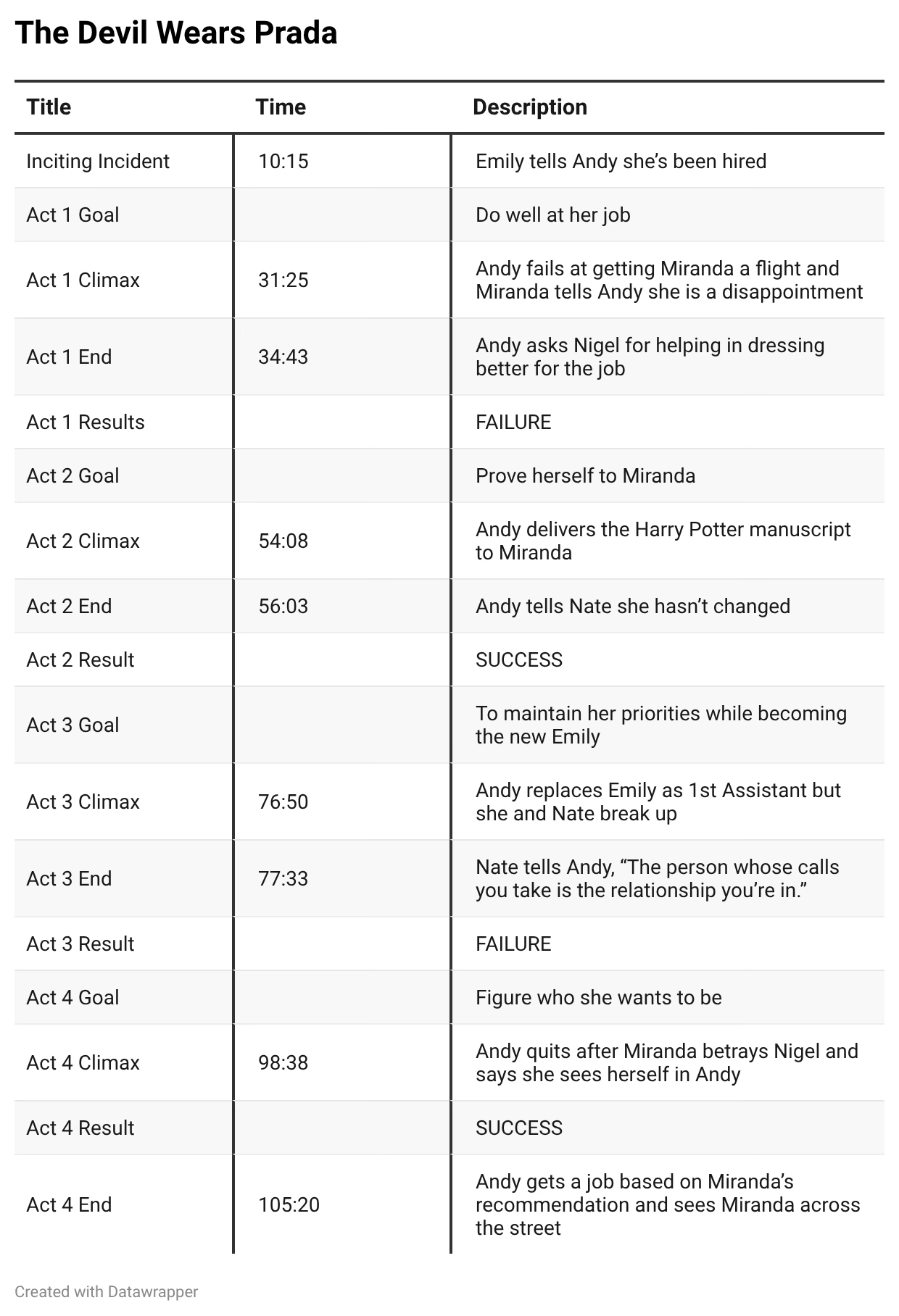
As we’ve constantly seen, middle sections (whether sequences or acts) are always tricky. This goes back to Syd Field and Three-Act Structure, and the difficulties of writing long middle sections. In The Devil Wears Prada Act 1 ends at 34:43 and Act 4 starts at 77:34, making the middle section roughly 43 minutes. While a little longer than the standard 30 minutes, 43 minutes is well within range of being one act, and so it would have been quite easy to label The Devil Wears Prada a three act movie. So why have I given it four? Simple—in that 43 minutes there are clearly two defining external goals and climaxes that give the movie structure. Though they are each short (just over 20 minutes each) the goals and climaxes of Act 2 and 3 are important to the movie’s overall structure.
Act 1 ends with Andy’s failure to get Miranda out of Miami. The result is a dressing down by both Miranda and Nigel. So Andy’s goal for Act 2 is clear: prove to Miranda she is capable of doing the job. Throughout the act she does a number of things to try to achieve this, including beginning to wear and appreciate the high end fashion of the Runway world. She also fails notably when delivering “The Book” to Miranda’s house. But the big challenge is to acquire the unpublished Harry Potter manuscript, which Andy successfully accomplishes. This is clearly an important moment, and becomes the Act 2 climax at the 54:08 mark (with the act ending a couple of minutes later).
Since she has proven herself to Miranda she is given greater and greater responsibility throughout the 3rd Act from being allowed to deliver “The Book” again, to attending the gala, to not having to put away the coats, to finally replacing Emily on the trip to Paris. Andy’s goal through all of this is to maintain her priorities as she slowly replaces Emily as Miranda’s main assistant. This climaxes when she officially becomes Miranda’s 1st assistant, but also ends up breaking up with Nate. As with the Movie Level Goal discussed above, the framing of the goal here is important. Simply stating the goal as “Succeed at the new responsibilities” would lead to a successful climax. But the act ends on Andy and Nate breaking up, which feels like a failure anyway you slice it. We could keep the “Succeed at her new responsibilities” goal and recognize it as a situation where success feels like failure (and we’ve seen movies that do this). Or we can conceptualize Andy’s goal in way to that allows her and Nate’s break-up to be a failure: “To maintain her priorities as she becomes Emily’s replacement.” In the end, either can work, but given the final act’s focus on Andy deciding who she wants to be, and the decision to quit, viewing the Act 3 climax as a failure fits the movie’s overall themes more strongly.
Observation #3: Mixing external and internal act goals
This leads to the Act 4 goal of Andy figuring out who she wants to be, which is clearly an internal goal. The internal movie level goal of deciding what her priorities are has obviously started to ramp up in Act 3. In Act 3 the Act goal is a combination of the external and internal. By Act 4, Andy has largely succeeded at her external movie level goal of receiving Miranda’s approval. This is tacit in her invitation to attend Paris Fashion Week (which notably happens before Emily breaks her leg). But Miranda still hasn’t voiced that approval directly and so like Act 3, Act 4 is a combination of the external and internal, but here the balance has shifted to the internal, with the only real external goal of the act being to warn Miranda about her potential firing. And, of course, in the Act 4 and movie level climax the external and internal come crashing together. Andy receives the stated approval she has sought, but realizes she no longer fully desires it (though again, it’s complicated).
This fine balancing of the external and internal in the second half of the movie is what gives the movie its emotional core and meaning. Yes, the movie is a fun fashion film with plenty of comedic moments, but like the movie Whiplash, it also asks what the price of success is, and whether that price is worth it. For Andy, the answer is it’s not worth it.
One final note: for many viewers (including myself), Andy’s decision to walk away was problematic, especially given the pressure she receives from her boyfriend Nate who constantly belittles her job and complains that she’s never around and that her values have changed (though for the most part they really haven’t). While he admits that being a chef isn’t any more important than being in fashion, it’s also worth noting that to be a successful chef would mean being as driven as Andy needs to be in her job. So I would encourage any of you who felt the same way to go see the sequel, The Devil Wears Prada 2, which I think does well to address these issues in a more nuanced fashion.