Scott Pilgrim vs. the World Structure Breakdown

Scott Pilgrim vs. the World, directed by Edgar Wright, is one of my favorite comedies (“Bread makes you fat?) and at six sequences, it does have a slightly unusual structure. Additionally, its unique mix of action, romance, and comedy makes it especially challenging to create. With all this in mind, I thought Scott Pilgrim would be a fun movie to analyze.
As always, these breakdowns contain SPOILERS, and are only recommended if you've already seen the movie. You can check my introduction to these breakdowns, to get an overview of my process and philosophy.
Feel free to let me know what you think in the comments below!
The Basics
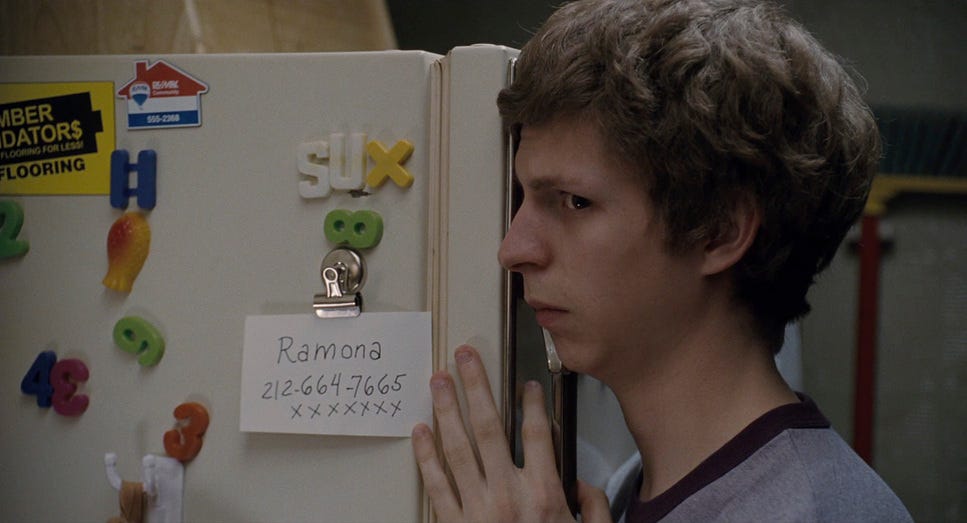
Director: Edgar Wright
Writers: Michael Bacall, Edgar Wright, Bryan Lee O’Malley
Release Date: 2010
Runtime: 112 Minutes
IMDB: https://www.imdb.com/title/tt0446029/?ref
Movie Level Goals

Protagonist: Scott Pilgrim
External: Win Ramona by defeating the 7 Evil Exes
SUCCESS | FAILURE | MIXED
Internal Goal: Gain Self-Respect
SUCCESS | FAILURE | MIXED
Goal Relationship: Internal Goal leads to External Goal (Scott must believe in himself in order to believe he can beat Gideon and therefore deserves to be with Ramona)
Three Observations
Observation #1: 7 Evil Exes, 6 Sequences
The most obvious question you might ask after watching Scott Pilgrim is why not make the easy choice and build one sequence around each battle that Scott (Michael Cera) has with Ramona’s (Mary Elizabeth Winstead) seven evil exes? There are a couple of answers. The first, and easiest, is that the structure would become overly predictable and boring. While a video game can work on repetitive levels, a movie, even based on video game structure and iconography, would struggle to keep an audience engaged if we literally had one sequence built around each battle. With seven sequences at minimum (and probably at least one or two to start the movie, we’d end up with 8-9 short sequences, which would make subplots particularly difficult to develop(see Observation #2). Additionally, the nature of the evil exes makes one sequence for each impractical. Let’s look at the actual list of Ramona’s exes:
1. Matthew Patel (Satya Bhabha)
2. Lucas Lee (Chris Evans)
3. Todd Ingram (Brandon Routh)
4. Roxie Richter (Mae Whitman)
5. & 6. Katayanagi Twins (Kyle and Ken) (Keita Saitô and Shôta Saitô)
7. Gideon Graves (Jason Schwartzman)

A few notes. First, Scott is surprised to find himself battling the first evil ex, Matthew Patel. Though Matthew sends an email, Scott’s surprise adds an element of surprise for the audience as well. Additionally, since he shows up out of the blue at the battle of the bands, Scott’s goal for that sequence is not to fight him, but to convince Ramona to date him. Matthew’s appearance becomes part of the climax that leads Ramona to confirm to Scott that he must battle her seven exes for them to date.
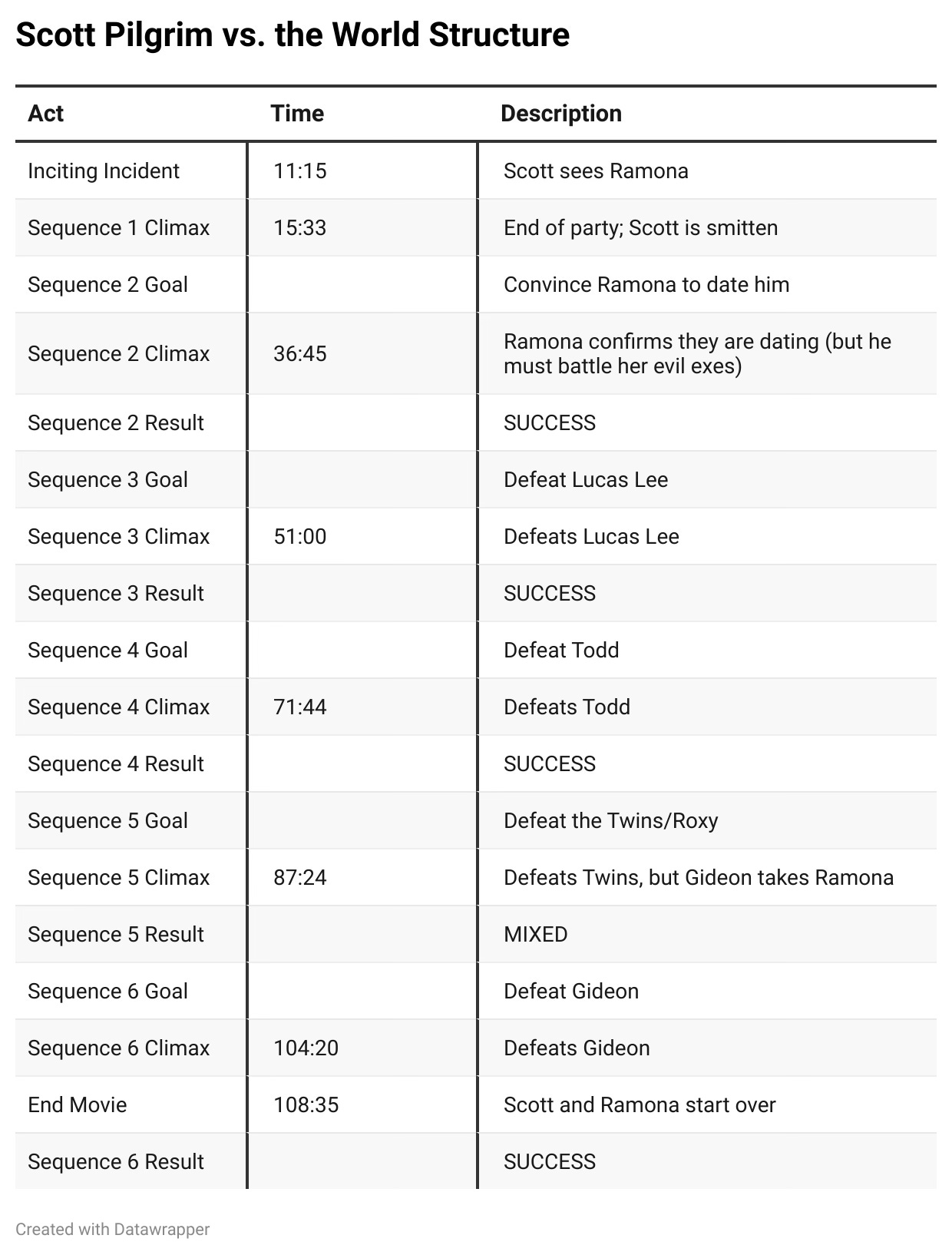
Interestingly, Lucas and Todd are each given their own sequence, and Scott’s goal for each sequence is to defeat them. Defeating Todd happens at the 71-72 minute mark, about 2/3 of the way through the movie (4 out of 6 sequences). We could imagine at this point that continuing the pattern could become repetitive at this point, and the movie cleverly does a few things. First, Roxy attacks Scott, who still hasn’t understood that he is battling “exes” and not “boyfriends” and thus doesn’t understand who Roxy is or why she wants to fight him. Additionally, by having Ramona fight Roxy, it saves the audience the potential uncomfortableness of having Scott fight a woman.
Defeating Roxy is combined with defeating the Katayangi twins, and of course it makes sense that though the twins are counted separately toward the seven, Scott must fight them together.
Finally, in the sixth and final sequence, the structure returns to expectations, and Scott must defeat Gideon to close out all seven challenges and eventually have the chance to truly start a relationship with Ramona.

Observation #2: Why the Long Sequences?
With six sequences, we are bound to see longer than normal sequences, unless the movie were to come in at under 90 minutes. At 108 minutes, we have an average length of 18 minutes per sequence which is definitely longer than the typical 15-minute long sequence. Our shortest sequence, as the table shows, is the first one, with the climax being Scott falling for Ramona at the library. This makes sense, as the first sequence can’t be too long, especially in this movie—Scott needs to meet Ramona and want to date her. Leaving this too late would leave the audience unsure of the direction of the movie.
The rest of the sequences range from 16-21 minutes. The main reason is that movie basically splits the attributes of longer act structure versus shorter sequence structure. Sequences allow for tighter cause and effect chains while act structure allows for a slightly looser cause and effect chain that allows for multiple plot lines. Scott Pilgrim vs. The World has to do a little of both. With an action-oriented base structure, sequences make sense. But this is also a romantic comedy dressed in action garb, and the movie has a large number of characters and plot lines: Scott pursuing Ramona, Scott figuring out what to do about Knives (Ellen Wong), the battle of the bands, setting up that Scott has an ex himself in Envy Adams (Brie Larson) the continuing setup of a large number of characters (the bandmates, Scott’s sister (Anna Kendrick), Scott’s roommate Wallace (Kieran Culkin), and Julie Powers (Aubrey Plaza)), and of course fighting all the evil exes.

Observation #3: Is Scott Pilgrim vs. The World Sexist?
Some commentators have criticized Scott Pilgrim for being sexist in its treatment of Scott’s need to fight Ramona’s exes to be with her, and Scott needing to defeat Gideon in order to “free” Ramona from his influence. Overall, I think this is a complex and nuanced discussion. I do agree that Scott having to free Ramona from Gideon’s influence takes away some of Ramona’s agency; it seems like having Ramona fight and defeat Gideon herself would be a strong ending. Having said that, having Scott fight the other exes I think is more complicated. Part of Scott’s journey is learning that the stereotype of a man being obsessed with his girlfriend’s past partners is itself outdated and sexist. In battling her exes, he is learning that her past is not what is important to the success or failure of their relationship. Additionally, Scott has multiple current or ex-girlfriends himself, and he treats one of them, Knives, quite poorly, in essence becoming a future evil ex of hers. He also treats Kim, who had a crush on him, with disregard in terms of her feelings toward him. Learning how to treat women is central to Scott’s growth and his internal goal—gaining self-respect for himself. Part of respecting himself is learning fight for what he wants, to not take the easiest path, and to learn to respect others—otherwise he’ll never truly be able to respect himself.