
John Wick has become one of the most influential action films of the past 10-15 years. Besides spawning three sequels and a spin-off (Ballerina), its producer David Leitch has become a well known action director with films like Atomic Blonde and Bullet Train. Their combination of heavily choreographed action, focus on style and production design, and use of A-List stars (Keanu Reeves, Charlize Theron, Brad Pitt, Ana de Armas) in what have often been considered “B-movies” has influenced much of our expectations for contemporary action-oriented movies. Of course, we don’t tend to watch these movies for complex characters or intricate plots, yet even the narrative structure of a movie like John Wick has a lot to teach us.
As always, these breakdowns contain SPOILERS, and are only recommended if you've already seen the movie. You can check my introduction to these breakdowns, to get an overview of my process and philosophy.
Feel free to let me know what you think in the comments below!
The Basics
Director: Chad Stahelski
Writers: Derek Kolstad
Release Date: 2014
Runtime: 101 Minutes
IMDB: https://www.imdb.com/title/tt2911666/?ref
Movie Level Goals
Protagonist: John Wick
External: Get revenge on the Tarasovs for his dog and car
SUCCESS | FAILURE | MIXED
Internal Goal: None
Motivation: To avenge the death of his dog
Goal Relationship: None
Three Observations
Observation #1: Internal Goal vs. Motivation
The characters in action thriller crime films don’t tend to have complex emotional lives, and we obviously don’t watch movies like John Wick for complex interpersonal drama. At the same time, even in contemporary genre movies we do expect to care about our protagonists, and perhaps more importantly, they need to have reasons for becoming involved in the fights, chases, and shoot-outs we love to watch in these movies. This brings us to a tricky division: the line between an internal goal and motivation. As you might have noted above, I’ve given our protagonist John Wick motivation (getting revenge for the death of his dog), but no internal goal. But couldn’t revenge for the death of his dog be an internal goal rather than simple motivation? After all, we generally link success of external and internal goals together, so we could easily say that John succeeds at his external goal of killing Iosef and Viggo, which leads to the success of his internal goal of getting revenge for the death of his dog. Additionally, motivation is internal isn’t it? The answer to all this—it’s complicated. The line between internal goals and motivation is thin, but I generally apply two tests:
Does the this internal state lead to a change in the character? Generally an internal goal is something that leads to internal conflict in the character, and they must change something about who they are internally in order to change as a person (usually in the form of growth). Sometimes characters are quite aware of this need, sometimes they slowly discover it, and sometimes they are barely aware of it. Examples might be overcoming grief, overcoming fear, believing in themselves or gaining self-confidence, loving themselves or receiving love, etc. On the other hand, motivation does not usually lead to internal change for the character. Their external circumstances may change as a result of their motivation leading to a successful outcome, but the character remains largely the same. Revenge is one of the most common motivators in film (especially action), but it rarely leads to internal change for the protagonist. John Wick successfully gets revenge for the death of his dog (which was given to him by his now dead wife), but having killed Iosef and Viggo, John’s grief over the loss of his wife and dog is not alleviated. Motivation sets the chain of action in motion, but rarely changes the internal life of the character.
Can we have a stand-alone scene that is just about this internal state that isn’t also about the external goal? With internal goals, the answer is yes. Characters can pursue an internal goal through talking about it or taking action on it. They can be involved in scenes that only address their internal goals: overcoming grief or fear, believing in themselves, loving themselves, etc. And these scenes can have nothing to do with the external goal. Motivation on the other hand is always inextricably tied to the external goal. Any scene that involves John pursuing revenge also involves him trying to kill Iosef and Viggo. He could have a scene where he talks about missing the puppy. But the moment he states that he wants revenge for his loss, he’s talking about his external goal as well. Motivation and external goals are always two sides of the same coin.
Observation #2: The Act 2 Midpoint!
If you know the history of act structure in Hollywood movies, you know that the popularization of three-act structure can be traced back primarily to Syd Field’s 1979 book Screenplay: The Foundation of Screenwriting. He certainly did not invent three-act structure—screenwriting manuals written well before his discuss three-act structure. But the popularity of his book certainly propelled the idea into the consciousness of screenwriters, director, producers, and even film fans. The derivation of the three-act structure is simple and old—it goes back to Aristotle’s observation in the Poetics that every play has a beginning, middle, and end. There’s a lot we could say about basing Hollywood film structure on the work of Aristotle, but that’s not the main point here.
After three-act structure became popularized many people began to question one of its foundational tenets—that the opening and closing acts were approximately 30 minutes long, and the middle was everything leftover, no matter how long—a typical 2-hour movie would have a 60-minute second act. This long Act 2 became a major obstacle—how could you fill 60 minutes with action and conflict without any change of direction or goal? To answer this, Field later introduced the idea of a mid-point, which divided the long Act 2 in half. Of course, you can guess what happened next—other screenwriting experts proposed that many movies have four acts rather than three—or more accurately that acts were balanced sections of around 30-minutes, and that depending on the length of of the movie, it might be three, four, five acts or more. If you’ve read any of my other breakdowns or my introduction to breakdowns, you know I subscribe to this approach. So, why I have said that John Wick has three acts with a midpoint, rather than going with the obvious answer that it has four acts?
Again, there are two primary answers:
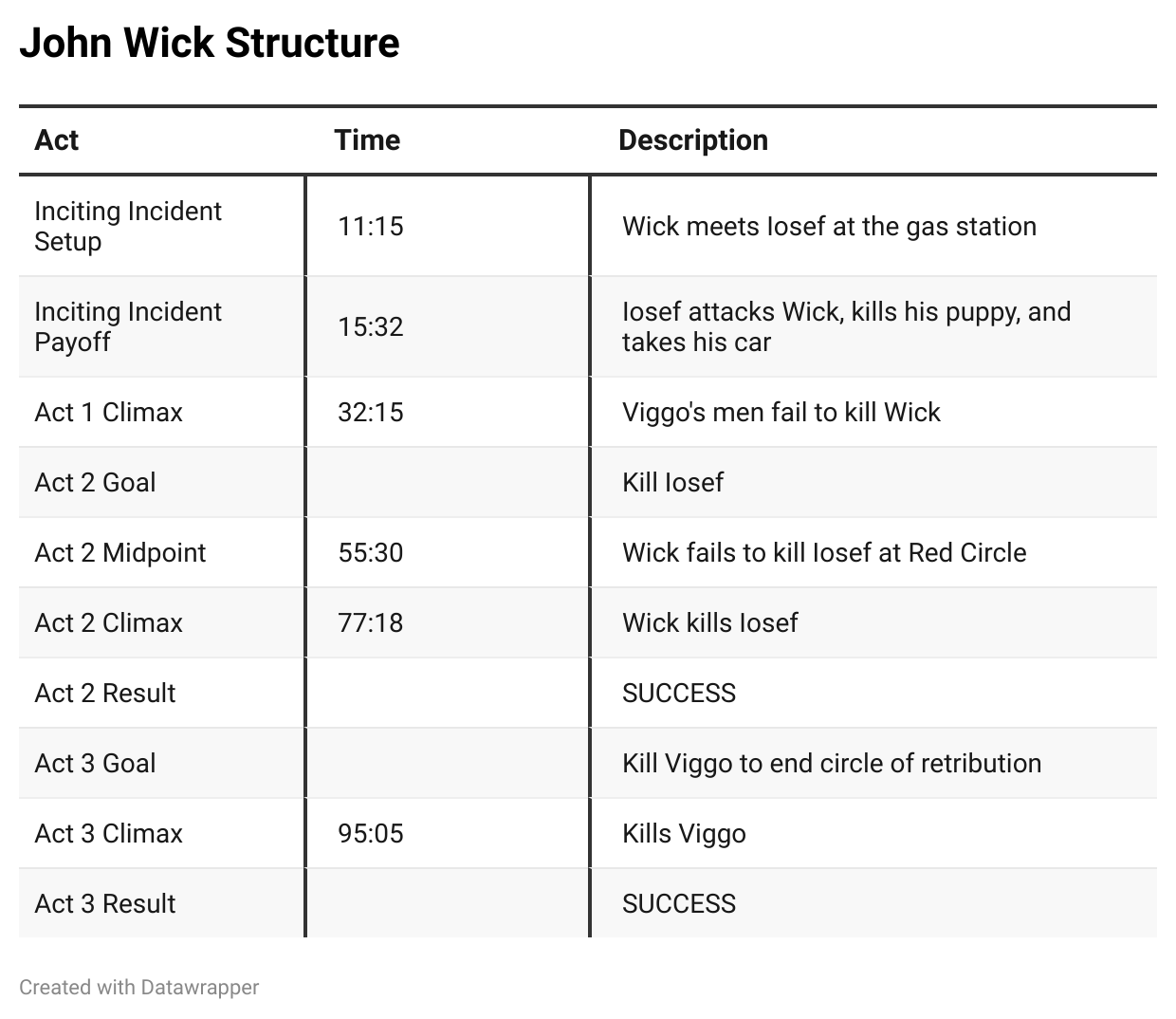
The total length of Act 2 is 45 minutes. Long for one act, short for two. If we divided Act 2 into two acts around the midpoint, we’d have a 23-minute act and a 22-minute act. These would both be on the short side, but certainly not unheard of. In fact, you probably noticed that Act 3 itself is only 18 minutes long. Nevertheless, 45 minutes creates an indeterminate section that could in essence go either way. I chose to keep it unified as one act, and the reason is found in answer two:
When Syd Field first defined acts he tended to define them as units that resulted in a change or turning point in the movie. This might be a decent description of most act climaxes or ends, but what defines the start of an act? The answer, as many of my posts detail (as does the Introduction to Breakdowns) is the protagonist’s goal. With the occasional exception of Act 1, each act (or sequence) is defined by the protagonist’s goal, and the climax is the success or failure of that goal. Here’s where John Wick’s 45-minute Act 2 gets interesting. John’s Act 2 goal is to kill Iosef. At the 55 minute mark, in the extended shoot-out at the Red Circle, John fails to kill Iosef. He’s failed at his Act 2 goal—so far so good. Usually, when characters fail at a goal, they have to give it up and move on to a new goal or a new formulation of the goal. But in John Wick, after the 55-minute mark, John’s goal is the same—to kill Iosef. And 22 minutes later, at the 77-minute mark, he does just that. If we break Act 2 into two acts around the midpoint, we need to answer a critical question—what would the new “Act 3” goal be? If an act is defined by a new goal, then we can’t really call the 22 minutes after the midpoint a new act. But with a 45 minute length, and a climactic moment halfway through, it makes perfect sense to see Act 2 as one act with a midpoint.
Observation #3: The Short Act 3
With two pretty long observations, I thought it best to keep this one short, just like Act 3. At 18 minutes, Act 3 is about as short as an act can be (in fact I’ve done breakdowns of movies with sequences that were the same length). So, yes 18 minutes for an act is short. But it still works as a self-contained act. First, it has a unique goal—for John to kill Viggo. Second, final acts are often the shortest. Unlike the earlier acts, final acts generally don’t introduce new characters, new subplots, new conflicts, etc. Their main function is to have the protagonist finally and directly pursue their movie level goal, which of course John does in Act 3. Third, and finally, action movies in particular (especially smaller scale movies based on crime—versus large scale Marvel style movies) often have very tight final acts, because the pursuit of a final goal is especially simple—kill the bad guy. This rarely needs much elaboration, planning, or extended detail, and rarely involves an extended resolution after the climax. Once the final act starts, the audience’s expectation is for the protagonist and antagonist to meet. So, John’s pursuit of revenge climaxes in a showdown with Viggo. John kills Viggo and the movie is over. Short and sweet, just like this final observation.