Drive Structure Breakdown
During the 2010’s, Nicolas Winding Refn became one of cinema’s foremost stylists (Only God Forgives, Neon Demon, Too Old To Die Young). Often his visual style overpowers the narrative, and he can be accused of embracing style over substance (though I’m a fan of pretty much all his work). His most well-known and accessible film, Drive (starring the amazing cast of Ryan Gosling, Carey Mulligan, Oscar Isaac, Bryan Cranston, Albert Brooks, Ron Perlman, and Christina Hendricks) manages to not only be visually compelling but also structurally and narratively compelling, create an incredibly precise structure that drives a romantic-action film to something much more lofty than its genre foundation.
As always, these breakdowns contain SPOILERS, and are only recommended if you've already seen the movie. You can check my introduction to these breakdowns, to get an overview of my process and philosophy.
Feel free to let me know what you think in the comments below!
The Basics
Director: Nicolas Winding Refn
Writers: Hossein Amini, James Sallis
Release Date: 2011
Runtime: 100 Minutes
IMDB: https://www.imdb.com/title/tt0780504/?ref
Movie Level Goals
Protagonist: The Driver
External: To protect Irene
SUCCESS | FAILURE | MIXED
Internal Goal: To find meaning in life through love
SUCCESS | FAILURE | MIXED
Goal Relationship: External Goal leads to Internal Goal
Three Observations
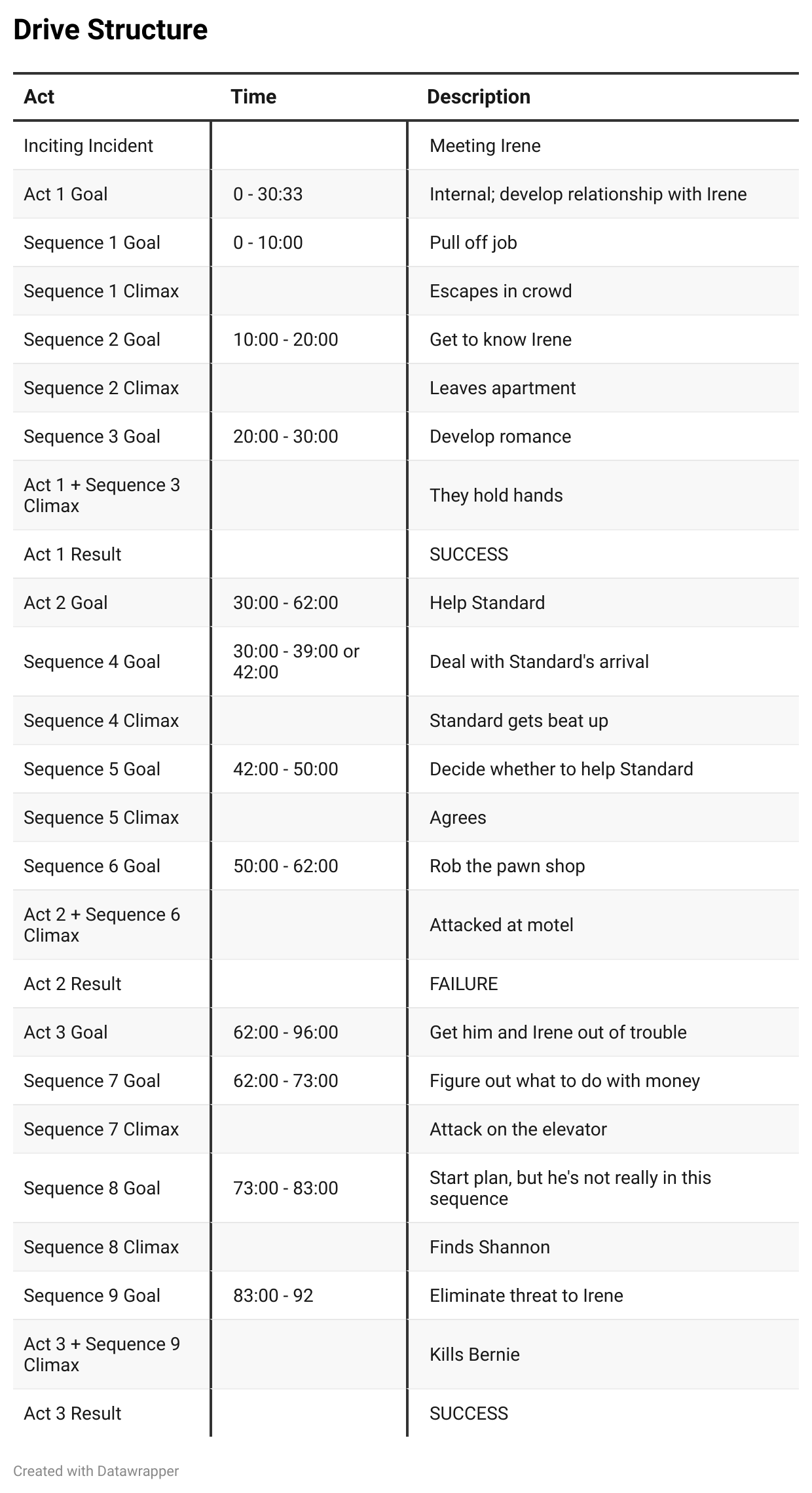
Observation #1: Nine Sequence, Three Act Structure
Drive has a unique and distinct structure which is relatively rare. While there are other movies that have a balanced Act/Sequence structure (both acts and sequences, with the same number of sequences in each act), it’s especially rare in a three-act 90-minute movie. The first challenge of any nested sequence within acts structure is that the goals of each sequence have to be oriented to the larger goal of that act. Generally, act structure allows for a looser structure with room for more plot lines and shifts in alignment. Conversely, sequences allow for a tighter cause and effect chain with more action and a tighter story, but limiting plot lines and shifts in alignment. Combining the two generally means sacrificing the looser structure of acts while still keeping the act goal and climax structure, which limits even more heavily what can be done with sequence goals. What’s even more unusual is doing all of this in just over 90 minutes. With three acts and nine sequences, each act must be strict in sticking to the approximately 30 minute length, and even more constricting, each sequence clocks in around 10 minutes each, making them quite tight and not allowing for much maneuverability within each sequence.
While the runtime of Drive is listed at 100 minutes, this includes the opening and closing credits, with the actual runtime clocking in around 95 minutes (and the movie ending at the 96-minute mark). The three acts run a very balanced 30, 32, and 33 minutes (including resolution). The sequences are even more precise (though the times in the table have been rounded). We can see that each of the first three sequences basically run 10-minutes each (again there is anywhere from 10-30 seconds variation in each). The Act 2 sequences are slightly more variable, but depending on how you designate them are also quite precise. Sequence 4, in which the Driver’s romance with Irene is interrupted by her husband Standard, could end at the 39-minute mark after The Driver and Standard’s “face-off” in the apartment building hallway or could end at the 42-minute mark when The Driver discovers Standard beat up in the parking garage. There are compelling cases for each, but as finding Standard beaten up feels more dramatic on the surface (though even that’s debatable), I’ve started Sequence 5 at the 42-minute mark. So you have sequence lengths of 12, 8, and 12 minutes for Sequences 4-6, or 9, 11 and 12 minutes, depending on where you mark the Sequence 4 climax, but either way these are incredibly precise and still quite close to the three 10-minute sequences of Act 1. Finally, Act 3 keeps the precision going with sequences of 11, 10, and 9 minutes (if we add the resolution, which we usually do, the final sequence stretches to 12 minutes. Again, whichever way you choose to look at it the Act Three sequences have remained incredibly precise in their running time.
The result is an incredibly precisely timed film; one of the most precise, if not the most precise, set of sequences I’ve ever analyzed. The big question is does this precision serve a purpose? I’ve made very clear in my introduction to these breakdowns, and in other breakdowns, that I make no claim that the writers or filmmakers had the specific structures that I describe in mind when they wrote the film. However, it’s hard not to see the precision of the movie’s structure as a reflection of the precision of The Driver, both in his driving ability and in his specific relationship to time. Before any job, he tells his clients, that once the job starts they have exactly 5-minutes, and anything that happens within that 5-minutes “he’s theirs.” But anything “a minute on either side of that and you’re on your own.” Whether intended or not, The Driver’s precision is nicely reflected by the incredibly tight precision of the nine sequence lengths in Drive.
Observation #2: Internal Goal Drives Act 1 and it’s Three Sequences
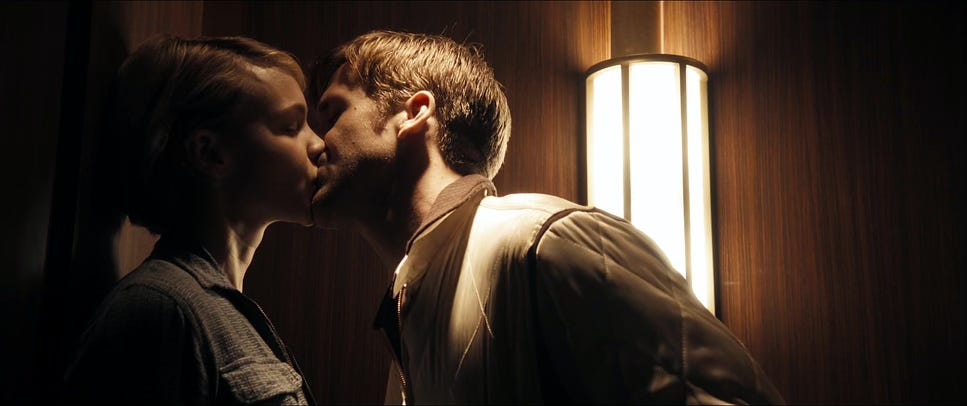
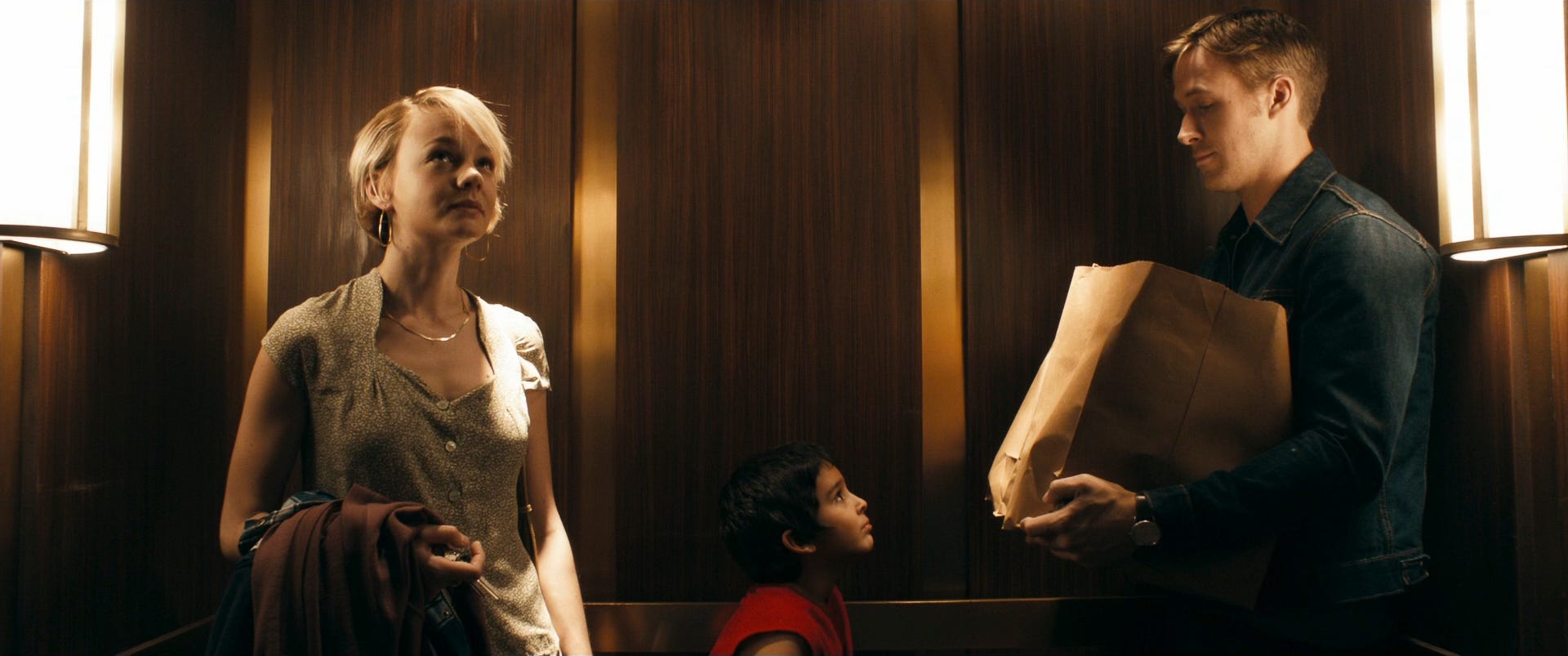
Despite, the precision of Drive, its first act is quite unusual in its goal structure. The inciting incident occurs at the 13:00 minute mark when The Driver meets Irene on the elevator. This is in line with both normal sequence and act structures. In a sequence-structured movie, the inciting incident is often at the climax of Sequence 1, or at the start of Sequence 2, which is what we find here. In a typical act structure, the inciting incident varies, but often happens around the 15-minute mark (which would place it halfway through the sequence making Sequence 2 a little unbalanced). What’s fascinating is the goal that arises from the inciting incident. Though it unfolds slowly, The Driver is clearly smitten with Irene and begins a relationship with her. His Act 1 goal is to develop a relationship with Irene which he does through the Sequence 2 goal (getting to know her) and Sequence 3 goal (romancing her). What’s fascinating is that while this does lead to his pursuit of the external goal of protecting her, it’s primarily focused on his internal goal of finding meaning in his life through love (specifically with Irene). There is no danger to Irene or her family in Act 1, so his Act 1 goal is limited to romance and the internal. This strong focus on the internal in the opening act is very unusual (Rocky 1 might be something somewhat similar). While The Driver’s internal goal doesn’t exactly disappear, it gets sidelined in Act 2 with the return of Standard, who The Driver decides to help because of his feelings for Irene. Of course, with Standard’s death, The Driver is free to pursue the internal goal in Act 3, where it merges with external, to protect her. This setup: Act 1: Internal Goal, Act 2: External Goal, Act 3: Combined External/Internal is both unusual and elegant. Lastly, the Act 1 focus on the internal goal, which generally doesn’t have strong breaks based on acts and climaxes, would lead many writers to write Act 1 without any sequences at all. But the introductory sequence introducing The Driver’s job as a getaway driver, followed by the title credits, does immediately setup the possibility of sequences.
Observation #3: Sequence 8 and The Missing Driver
As I note in the table, The Driver largely disappears from Sequence 8, which is also somewhat unusual. As I noted above, sequence structures lend themselves to restricted alignment where we stick with the protagonist pretty much throughout the film. This is because changing the alignment from the protagonist within the limited time frame of a sequence can be challenging. Either we don’t have much time to leave the protagonist because their goal requires most of the limited running time of a sequence, or we leave them for most of the sequence to focus on another character(s) and are unexpectedly thrown out of alignment with the protagonist for a fairly long time.
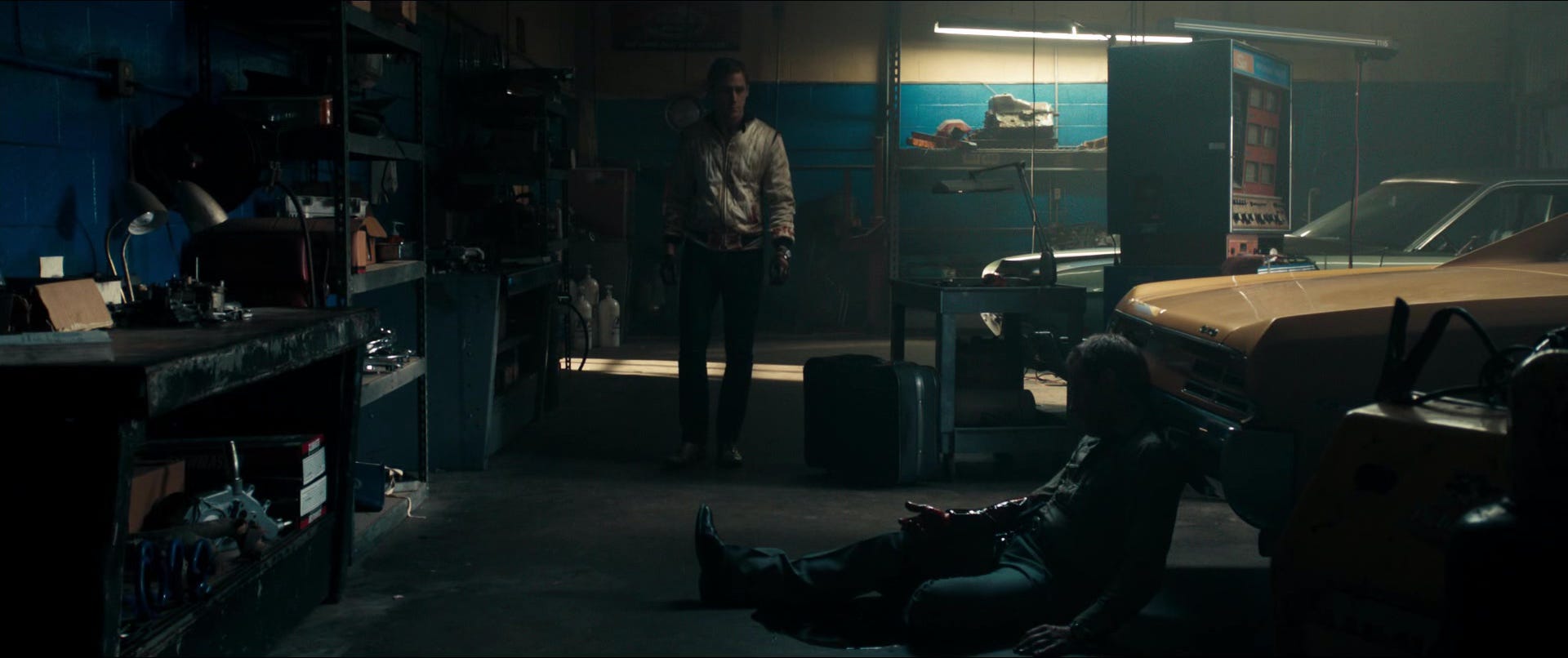
So what’s going on with Sequence 8? I think there are three things happening. The sequence starts with The Driver confronting Shannon over the hitman ambushing him and Irene in the elevator. This is important because the scene sets-up The Driver’s goal—to deal with the threat posed by Bernie and Nino—by having Shannon give The Driver exposition that leads to Nino as the immediate threat. The opening of the sequence ends in voice over with Shannon asking The Driver what he plans to do. One choice would be to spend the rest of the sequence setting up The Driver’s plan. However, the plan is not that complicated, which leads to the first of our three reasons for the structure of Sequence 8. After the voice over, the film cuts to a scene between Bernie and Nino, where we get further exposition and fully understand the threat to Shannon, Irene, and The Driver. By cutting away from The Driver, the filmmakers are largely freed from having to develop scenes in which The Driver enacts a plan. For the most part this wouldn't be especially exciting—the sequence actually makes it more intriguing by leaving The Driver and leaving his planning to the imagination. The cut to Bernie and Nino introduces the second reason for Sequence 8’s structure—it allows us to shift alignment to the antagonists which creates suspense. We know their plan and wonder what will happen. After the scene with Bernie and Nino, we return briefly to The Driver, which is a clever move. We see him steal a mask from the film set. This serves two purposes. The first is to simply realign us with The Driver who we are used to being with throughout the movie. The second is that we at least get to see some aspects of his planning. We then leave The Driver again, and cut to the key scene in which Bernie kills Shannon. This leads to the third reason for Sequence 8’s structure. After Bernie leaves Shannon, still dying, The Driver arrives to find Shannon dying. While the audience knows what’s happening, The Driver experiences the surprise of finding Shannon. The film could have stayed with The Driver therefore creating surprise for both The Driver and the audience. But by allowing the audience to see the murder of Shannon, The Driver’s surprise becomes that much more heartbreaking because we don’t experience the surprise, freeing us to focus fully on The Driver’s reaction (we also get the payoff of The Driver’s warning to Shannon at the start of the sequence. This sequence structure: The Driver and Shannon, Bernie and Nino, The Driver, Bernie and Shannon, then finally The Driver and Shannon might be a little unusual but accomplishes exactly what it needs to do: establishing The Driver’s goal, creating suspense, hinting at the The Driver’s plan, then creating the heartbreak of his discovery of the dying Shannon.
Overall, while the visual structure of Drive (like most of Nicolas Winding Refn’s films) is what most audience tend to focus on, the narrative structure is equally compelling and makes for a unique case study of sequence and act structure combined.